
DECC Review of the Feed-in Tariff Scheme concluded – where to now?
Late in December the Department for Energy and Climate Change published their conclusions to the Feed-in Tariff scheme review. The full text can be found here.
Whilst not all of the cuts have been quite as deep as initially proposed, the hubris of COP21 is not likely to flush through to National Policy anytime soon. The new tariffs are set out as follows:
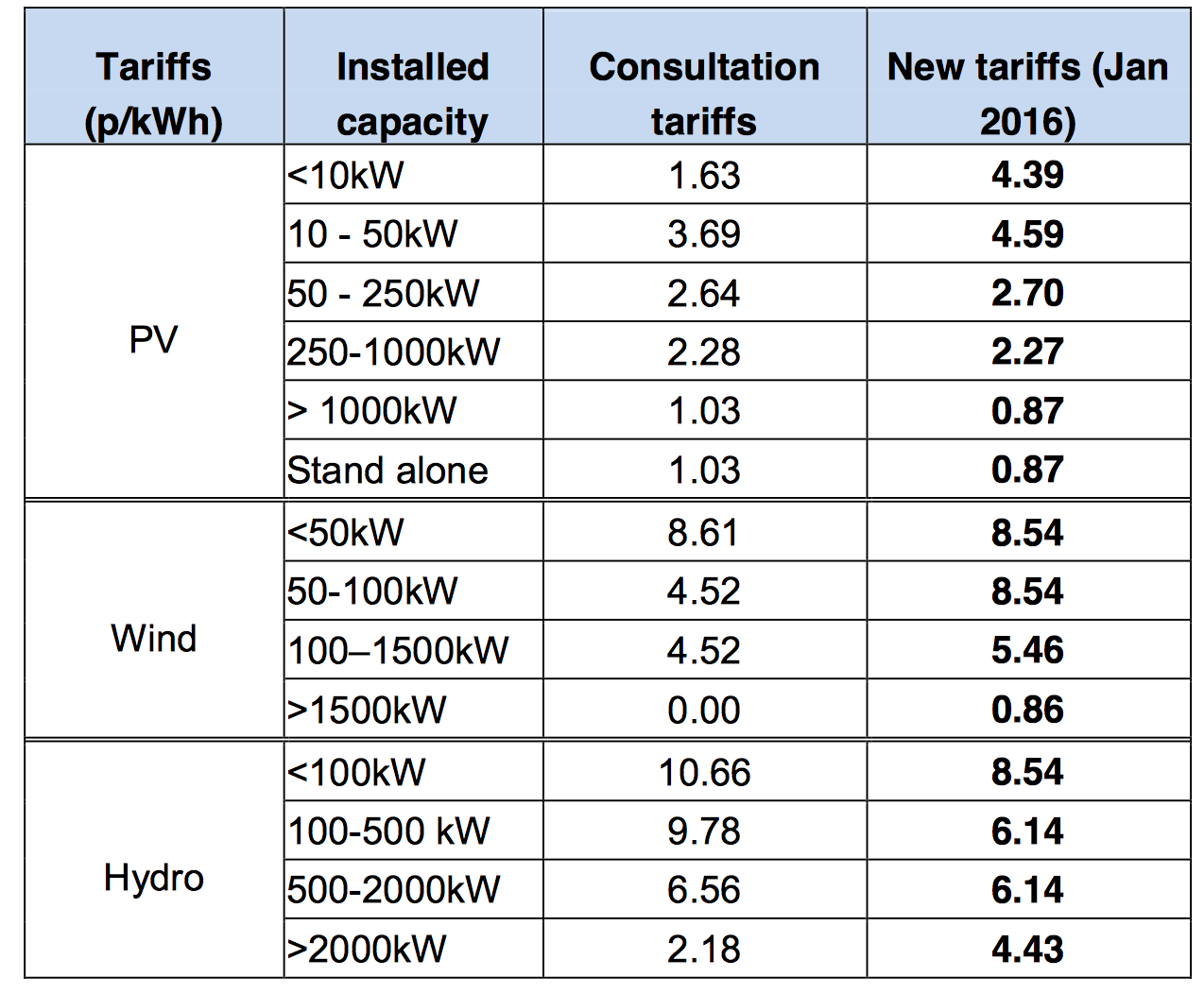
Hydro has taken a further bashing, but wind and solar have had a small reprieve from the initial proposed figures.
DECC have set revised levels of return at 4.8% for solar, 5.9% for wind and 9.2% for hydro. Time will tell if this is enough to keep people interested, or if manufacturers are able to reduce the deployment cost to sweeten these figures.
We expect that small solar will adapt, but small wind may find things more difficult given the extra planning risks (especially in England!) although Scotland and Wales might see the odd thing come through. On a positive note we might not see as many turbines capped at the slightly artificial 500kW level, with the sweet spot moving more towards the 0.8 to 1.5MW range. We can help here!
Pre-accrediatation is to be re-introduced for projects over 50kW from Feb 2016, but this will leave a number of those with projects that came in between September 15 and Feb 16 asking what about us?
Another area of uncertainty will be the linking of degression to deployment figures for particular technologies and particular bands.
As usual, there is an abundance of green rhetoric at the top level, but this is not being reflected in policies that encourage deployment on the ground. In the short term many projects are likely to stall as a result of the recent support changes and we are going to have to wait and see if and where the industry is able to recover.
Projects can still work out to be attractive, particularly if integrated into existing businesses, but very careful planning is required.
Related posts
The Prime Minister Theresa May has today announced the start of consultation on proposed changes to the National Planning Policy Statement with the aim of delivering more homes across
Secretary of State for Transport Chris Grayling is expected to confirm the new route for Phase 2b of HS2 later today. This announcement coincides with the award of approx
The Valuation Office Agency (VOA) has announced changes to business rates for solar PV systems and these new rates are set to come in to force in April 2017.
One of the intentions of the Planning Act 2008 was to make the permitting of major infrastructure projects more straightforward by combing planning consent and the Compulsory Purchase Order (CPO)
The current local electricity distribution network has been supplying North Shropshire with electricity reliably for many years. But with future growth plans in the region planned up to
In the energy industry a lot is being said about the development in battery storage technology. After the fall in renewable incentives a lot of focus is being given to