
DECC Review of the Feed-in Tariff Scheme concluded – where to now?
Late in December the Department for Energy and Climate Change published their conclusions to the Feed-in Tariff scheme review. The full text can be found here.
Whilst not all of the cuts have been quite as deep as initially proposed, the hubris of COP21 is not likely to flush through to National Policy anytime soon. The new tariffs are set out as follows:
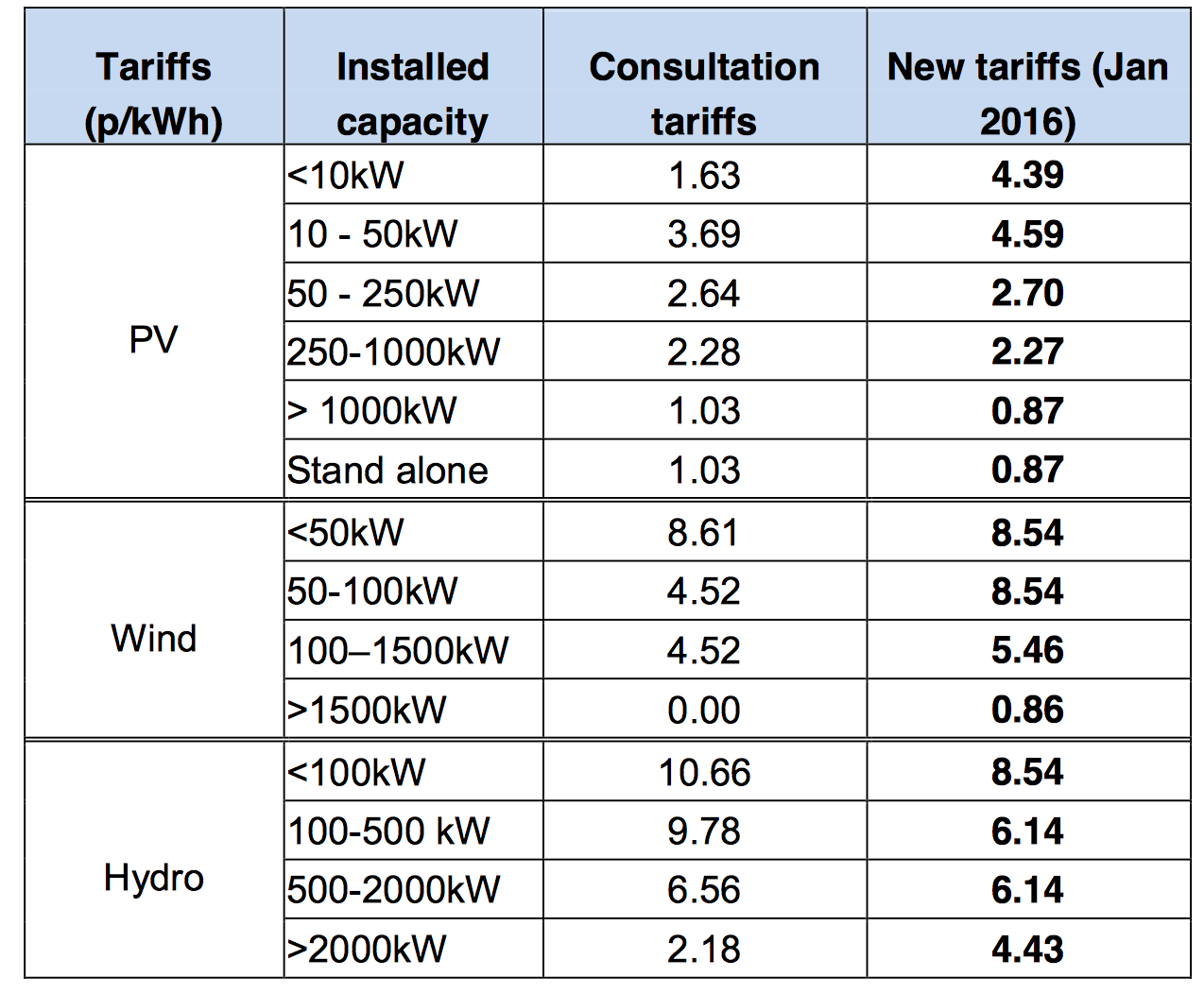
Hydro has taken a further bashing, but wind and solar have had a small reprieve from the initial proposed figures.
DECC have set revised levels of return at 4.8% for solar, 5.9% for wind and 9.2% for hydro. Time will tell if this is enough to keep people interested, or if manufacturers are able to reduce the deployment cost to sweeten these figures.
We expect that small solar will adapt, but small wind may find things more difficult given the extra planning risks (especially in England!) although Scotland and Wales might see the odd thing come through. On a positive note we might not see as many turbines capped at the slightly artificial 500kW level, with the sweet spot moving more towards the 0.8 to 1.5MW range. We can help here!
Pre-accrediatation is to be re-introduced for projects over 50kW from Feb 2016, but this will leave a number of those with projects that came in between September 15 and Feb 16 asking what about us?
Another area of uncertainty will be the linking of degression to deployment figures for particular technologies and particular bands.
As usual, there is an abundance of green rhetoric at the top level, but this is not being reflected in policies that encourage deployment on the ground. In the short term many projects are likely to stall as a result of the recent support changes and we are going to have to wait and see if and where the industry is able to recover.
Projects can still work out to be attractive, particularly if integrated into existing businesses, but very careful planning is required.
Related posts
Following the adoption of the Local Plan Strategy last year, the council is preparing a number of additional planning policy documents. These are being consulted on between 11 September
Earlier today DEFRA published their response to the Consultation on National Policy Statement for Water Resources Infrastructure – types and sizes of projects. This effectively sets the criteria to determine
The government has invited councils and developers to bid for support and funding to deliver 'discrete new settlements' or 'transformational' redevelopments of existing settlements, under criteria set out in
The Government is consulting on the possible inclusion of shale gas production projects as part of the NSIP regime here. They are particularly interested to hear from: onshore oil
The Crown Estate holds industry and stakeholder engagement to explore potential new offshore wind leasing.
It doesn't seem like that long ago that the UK was in the initial throws of a wind energy revolution. Unfortunately, UK planning policy (and a change of government)