
DECC Review of the Feed-in Tariff Scheme concluded – where to now?
Late in December the Department for Energy and Climate Change published their conclusions to the Feed-in Tariff scheme review. The full text can be found here.
Whilst not all of the cuts have been quite as deep as initially proposed, the hubris of COP21 is not likely to flush through to National Policy anytime soon. The new tariffs are set out as follows:
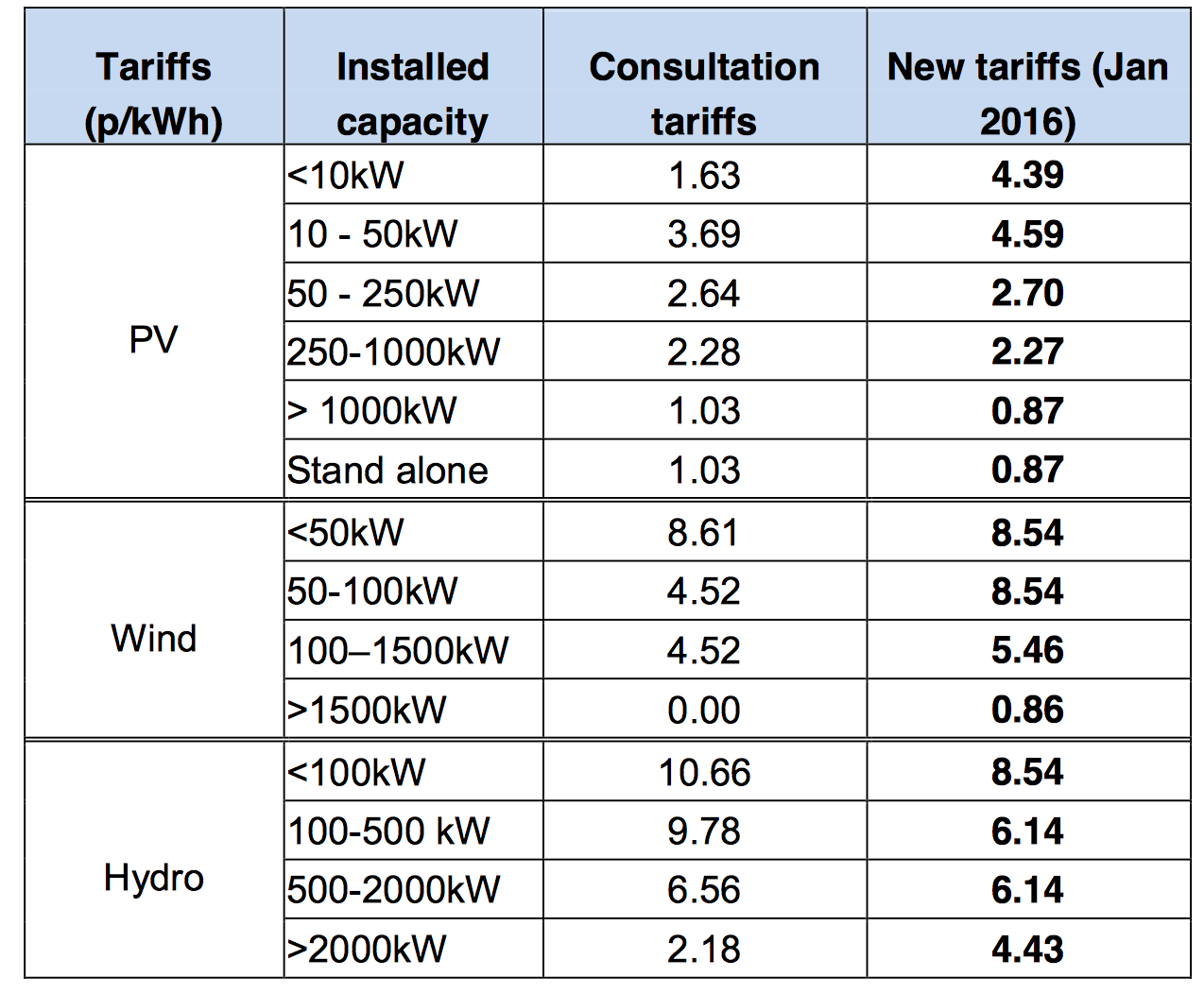
Hydro has taken a further bashing, but wind and solar have had a small reprieve from the initial proposed figures.
DECC have set revised levels of return at 4.8% for solar, 5.9% for wind and 9.2% for hydro. Time will tell if this is enough to keep people interested, or if manufacturers are able to reduce the deployment cost to sweeten these figures.
We expect that small solar will adapt, but small wind may find things more difficult given the extra planning risks (especially in England!) although Scotland and Wales might see the odd thing come through. On a positive note we might not see as many turbines capped at the slightly artificial 500kW level, with the sweet spot moving more towards the 0.8 to 1.5MW range. We can help here!
Pre-accrediatation is to be re-introduced for projects over 50kW from Feb 2016, but this will leave a number of those with projects that came in between September 15 and Feb 16 asking what about us?
Another area of uncertainty will be the linking of degression to deployment figures for particular technologies and particular bands.
As usual, there is an abundance of green rhetoric at the top level, but this is not being reflected in policies that encourage deployment on the ground. In the short term many projects are likely to stall as a result of the recent support changes and we are going to have to wait and see if and where the industry is able to recover.
Projects can still work out to be attractive, particularly if integrated into existing businesses, but very careful planning is required.
Related posts
The economic viability of commercial rooftop solar installations could be severely damaged next year under plans to increase business rates taxes by up to eight times the current levels following
As at the start of February 2016, many farmers will not have received their 2015 BPS payments. The RPA is under increasing pressure to make these payments and we
Across the Northwest/West Mids/North Wales region we have seen a general slowing in the value of residential development land over the last 12 months as more sites come to
After more than a decade of steady growth, the latter part of 2015 saw a slight reduction in the price of UK farmland in some of the most valuable
We are used to constant political upheaval in the renewable energy sector, but the last six months have been particularly difficult. Many are still looking at once viable projects
A number of interesting planning appeals concerning rural cases have been delivered in the last few weeks. Firstly, an appeal was dismissed for a new agricultural dwelling on a