
Major Infrastructure and Compulsory Purchase
One of the intentions of the Planning Act 2008 was to make the permitting of major infrastructure projects more straightforward by combing planning consent and the Compulsory Purchase Order (CPO) into the Development Consent Order (DCO). It is debatable whether or not it has had the desired effect, rather than merely front loading the process to the statutory pre application stages which lie outside of the determination period set for PINS.
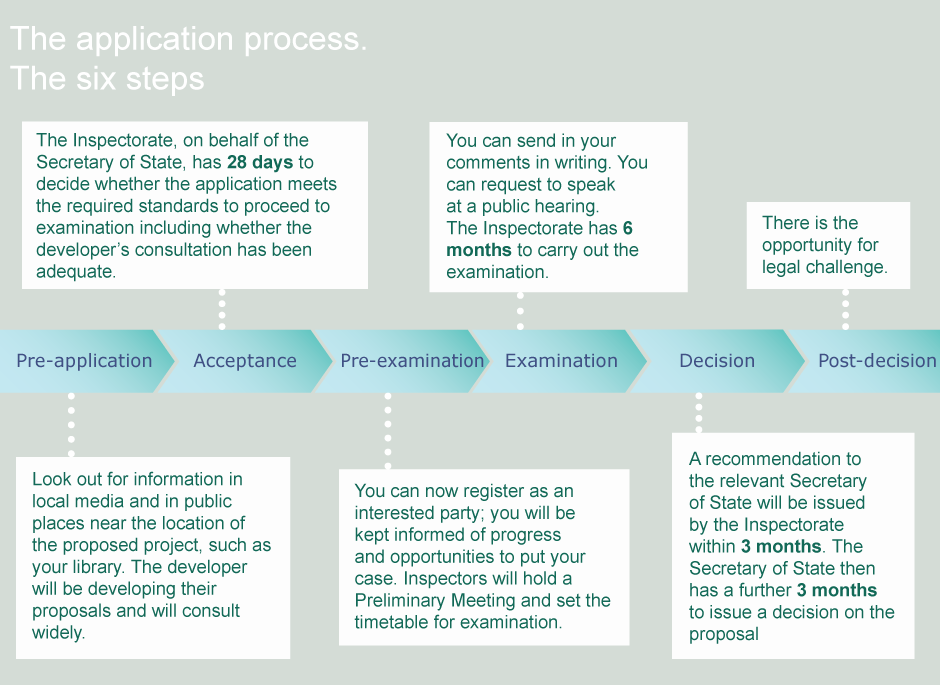
The governments own illustration above sets out the timelines involved in the DCO process, but it doesn’t show that the pre-application process is often between 3 and 5 years.
Either way, on approval the developer will have gained powers to obtain the specific land and rights that are required to carry out the development over land in which they have no existing legal interest. These developers are not only the large energy companies, authorities and agencies operating in the public good as one might expect, but include numerous private enterprises operating on a purely commercial basis.
We are starting to see more projects coming through the process from those that are high profile, such as HS2, to more local developments such as Wrexham Energy Centre and SPEN’s new 132kV line.
The developer is strongly encouraged by PINS to seek voluntary agreement to acquire land rights early in the DCO process, ideally before the application stage, but for affected landowners the threat of compulsory powers can often confuse their negotiating capacity.
Recent changes to the compulsory purchase rules have been brought in by Part 7 of the Housing and Planning Act 2016 and the government is consulting on further reforms, all of which makes the process more complicated than ever before.
Any landowners who are approached as being affected by a major infrastructure project should take expert advice before considering their next steps. There is often no need to be pushed into a hasty decision given the timeframes over which these projects gestate.
Related posts
As at the start of February 2016, many farmers will not have received their 2015 BPS payments. The RPA is under increasing pressure to make these payments and we
Across the Northwest/West Mids/North Wales region we have seen a general slowing in the value of residential development land over the last 12 months as more sites come to
After more than a decade of steady growth, the latter part of 2015 saw a slight reduction in the price of UK farmland in some of the most valuable
We are used to constant political upheaval in the renewable energy sector, but the last six months have been particularly difficult. Many are still looking at once viable projects
A number of interesting planning appeals concerning rural cases have been delivered in the last few weeks. Firstly, an appeal was dismissed for a new agricultural dwelling on a
Late in December the Department for Energy and Climate Change published their conclusions to the Feed-in Tariff scheme review. The full text can be found here. Whilst not all