
Major Infrastructure and Compulsory Purchase
One of the intentions of the Planning Act 2008 was to make the permitting of major infrastructure projects more straightforward by combing planning consent and the Compulsory Purchase Order (CPO) into the Development Consent Order (DCO). It is debatable whether or not it has had the desired effect, rather than merely front loading the process to the statutory pre application stages which lie outside of the determination period set for PINS.
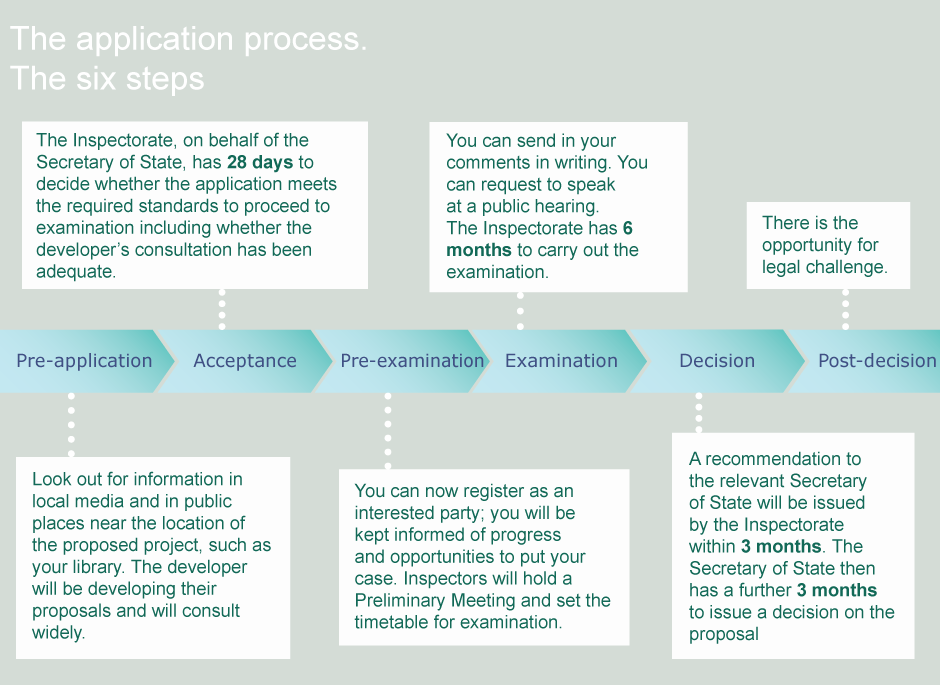
The governments own illustration above sets out the timelines involved in the DCO process, but it doesn’t show that the pre-application process is often between 3 and 5 years.
Either way, on approval the developer will have gained powers to obtain the specific land and rights that are required to carry out the development over land in which they have no existing legal interest. These developers are not only the large energy companies, authorities and agencies operating in the public good as one might expect, but include numerous private enterprises operating on a purely commercial basis.
We are starting to see more projects coming through the process from those that are high profile, such as HS2, to more local developments such as Wrexham Energy Centre and SPEN’s new 132kV line.
The developer is strongly encouraged by PINS to seek voluntary agreement to acquire land rights early in the DCO process, ideally before the application stage, but for affected landowners the threat of compulsory powers can often confuse their negotiating capacity.
Recent changes to the compulsory purchase rules have been brought in by Part 7 of the Housing and Planning Act 2016 and the government is consulting on further reforms, all of which makes the process more complicated than ever before.
Any landowners who are approached as being affected by a major infrastructure project should take expert advice before considering their next steps. There is often no need to be pushed into a hasty decision given the timeframes over which these projects gestate.
Related posts
The Prime Minister Theresa May has today announced the start of consultation on proposed changes to the National Planning Policy Statement with the aim of delivering more homes across
Secretary of State for Transport Chris Grayling is expected to confirm the new route for Phase 2b of HS2 later today. This announcement coincides with the award of approx
The Valuation Office Agency (VOA) has announced changes to business rates for solar PV systems and these new rates are set to come in to force in April 2017.
The current local electricity distribution network has been supplying North Shropshire with electricity reliably for many years. But with future growth plans in the region planned up to
In the energy industry a lot is being said about the development in battery storage technology. After the fall in renewable incentives a lot of focus is being given to
The economic viability of commercial rooftop solar installations could be severely damaged next year under plans to increase business rates taxes by up to eight times the current levels following