
Major Infrastructure and Compulsory Purchase
One of the intentions of the Planning Act 2008 was to make the permitting of major infrastructure projects more straightforward by combing planning consent and the Compulsory Purchase Order (CPO) into the Development Consent Order (DCO). It is debatable whether or not it has had the desired effect, rather than merely front loading the process to the statutory pre application stages which lie outside of the determination period set for PINS.
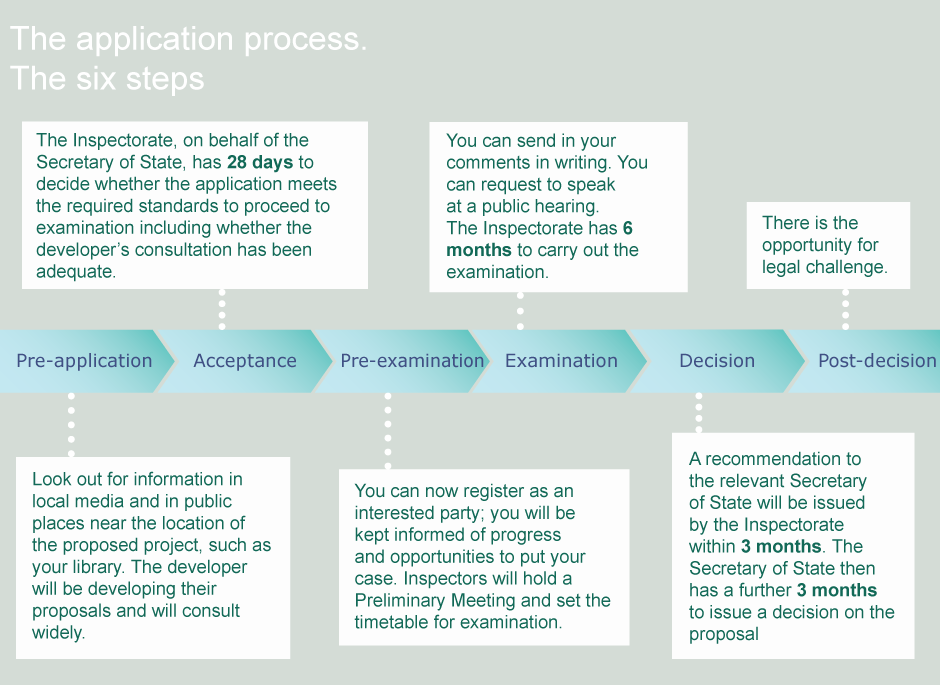
The governments own illustration above sets out the timelines involved in the DCO process, but it doesn’t show that the pre-application process is often between 3 and 5 years.
Either way, on approval the developer will have gained powers to obtain the specific land and rights that are required to carry out the development over land in which they have no existing legal interest. These developers are not only the large energy companies, authorities and agencies operating in the public good as one might expect, but include numerous private enterprises operating on a purely commercial basis.
We are starting to see more projects coming through the process from those that are high profile, such as HS2, to more local developments such as Wrexham Energy Centre and SPEN’s new 132kV line.
The developer is strongly encouraged by PINS to seek voluntary agreement to acquire land rights early in the DCO process, ideally before the application stage, but for affected landowners the threat of compulsory powers can often confuse their negotiating capacity.
Recent changes to the compulsory purchase rules have been brought in by Part 7 of the Housing and Planning Act 2016 and the government is consulting on further reforms, all of which makes the process more complicated than ever before.
Any landowners who are approached as being affected by a major infrastructure project should take expert advice before considering their next steps. There is often no need to be pushed into a hasty decision given the timeframes over which these projects gestate.
Related posts
Following the adoption of the Local Plan Strategy last year, the council is preparing a number of additional planning policy documents. These are being consulted on between 11 September
Earlier today DEFRA published their response to the Consultation on National Policy Statement for Water Resources Infrastructure – types and sizes of projects. This effectively sets the criteria to determine
The government has invited councils and developers to bid for support and funding to deliver 'discrete new settlements' or 'transformational' redevelopments of existing settlements, under criteria set out in
The Government is consulting on the possible inclusion of shale gas production projects as part of the NSIP regime here. They are particularly interested to hear from: onshore oil
The Crown Estate holds industry and stakeholder engagement to explore potential new offshore wind leasing.
It doesn't seem like that long ago that the UK was in the initial throws of a wind energy revolution. Unfortunately, UK planning policy (and a change of government)